A11yExtensions: Accessibility Extensions to Augment Mobile AI Assistive Technology In-Situ

Jaylin Herskovitz, Ellie Seehorn, Ather Jammoa, Jason Meddaugh, Anhong Guo
Tufts University, University of Michigan, A.T. Guys
ACM CHI conference on Human Factors in Computing Systems (CHI '26)
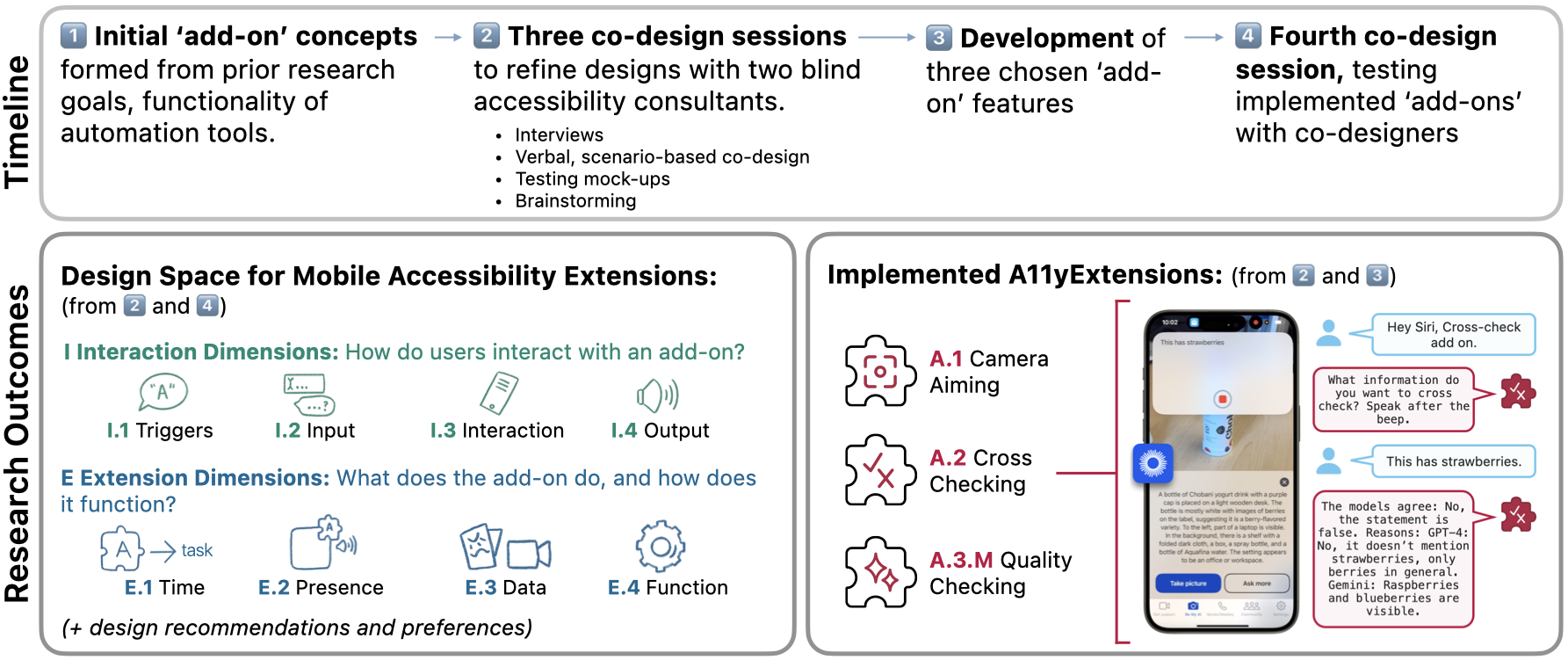
An overview of A11yExtensions. (A) A timeline of the research process: 1. Initial add-on concepts formed from prior research goals, functionality of automation tools. 2. Three co-design sessions to refine designs. 3. Development of three chosen add-on features. 4. Evaluation through user testing with co-designers. (B) Design space for mobile accessibility extensions, showing two main categories. Interaction Dimensions: How do users interact with an add-on? (Triggers, input, interaction, output.) Extension Dimensions: What does the add-on do, and how does it function? (Time, presence, data, function). (C) Implemented A11yExtensions: A.1 Camera Aiming, A.2 Cross Checking, A.3.M Quality Checking. Shows an example interaction with A.2 Cross Checking: There is a screenshot of the app Be My Eyes with a speech recording box overlaid as a notification. There are speech bubbles showing a conversation. User: Hey Siri, Cross-check add-on. Siri: What do you want to cross-check? Speak after the beep. User: This has strawberries. Siri: The models agree: no, the statement is false. Reasons:...'

We present A11yExtensions, a design space and set of implemented 'add-ons' to mobile assistive technology powered by existing automation tools. A11yExtensions was generated through co-design using functional prototypes as design probes.

Abstract

Existing visual AI assistive technologies have usability gaps, and may need additional adaptations and features to serve users' needs. We propose A11yExtensions, in-situ interventions that augment existing mobile AI assistive technology with add-on services. Add-ons include features that have been researched but are not yet deployed (e.g., cross-checking AI results), or that are only available in certain applications (e.g., camera aiming assistance). Through co-design sessions with two blind accessibility professionals, we designed and implemented three exemplar extensions, leveraging mobile automation tools to invoke add-ons, enabling just-in-time interventions for adaptability. We found that A11yExtensions provide opportunities to test new features and a new degree of flexibility and customization, though they introduce additional onboarding and communication challenges. We also derived a design space of accessibility extensions as a basis for future extension designs. Overall, A11yExtensions is a demonstration of the effectiveness of deploying new features in-situ via automation, with the technologies people actually use in their day-to-day lives.

Video Presentation (Coming Soon!)

Citation

Jaylin Herskovitz, Ellie Seehorn, Ather Jammoa, Jason Meddaugh, and Anhong Guo. 2026. A11yExtensions: Accessibility Extensions to Augment Mobile AI Assistive Technology In-Situ. In Proceedings of the 2026 CHI Conference on Human Factors in Computing Systems (CHI '26), April 13-17, 2026, Barcelona, Spain. ACM, New York, NY, USA, 23 pages. https://doi.org/10.1145/3772318.3791559